

Is FX Trading a Guaranteed Loss? Why Traders Lose and the Logic Behind It
Many beginner traders ask themselves, “Can you really win at FX?” In fact, statistics are said to show that over 90% of FX traders fail to turn a profit over the long term. But is this “destined to lose” outcome truly unavoidable? In this article, I’ll explain the fundamental reasons and logic behind why so many traders can’t win, and lay out a path to becoming a winning trader.
The Probabilistic Truth About FX Trading

To understand the essence of FX, we first need to look at it from a probabilistic point of view.
At Its Core, a 50/50 Game
A chart can only go up or go down. In that sense, the probability of going up or down is 50% each. In other words, if you just entered at random, your win rate should be 50% over the long run. Yet actual trading results don’t turn out that way. Why is that?
You Actually Start in the Red
One reason traders can’t win at FX is the fact that the moment you enter, you are already starting from a negative position.
- Spread cost: the difference between the bid and ask prices
- Trading commissions: some brokers charge a separate fee
- Slippage: depending on market conditions, there can be a gap between your order price and your fill price
For example, with a 1.0 pips spread, you need a price move of at least 1.0 pips just to come out ahead. That alone pulls your odds slightly below a pure 50%.
Psychological Biases Create the Conditions for Losing
Human psychology has a big impact on your win rate.
Prospect Theory – Asymmetric Reactions to Gains and Losses
According to prospect theory in behavioral economics, people tend to react more strongly to losses than to gains. Specifically:
- They want to close winning positions early (the urge to lock in profits)
- They struggle to cut the loss on losing positions (aversion to realizing losses)
This asymmetric behavior pattern has a major impact on trading results.
The Asymmetry Between Take Profit and Stop Loss Timing
For example, when both the take profit and the stop loss are set at the same 50 pips, many traders behave like this when closing their positions.
- Take profit: It hit 50 pips, but let’s wait and see a bit longer → It’s coming back down. Looks like it won’t go any further, so let’s take profit → Profit taken at 40 pips
- Stop loss: An adverse move has put me down 40 pips. I need to cut the loss. → I can’t hold any longer. It’s reached my stop-loss level, so I’ll cut it → Stopped out at 50 pips
Because of this asymmetric exit timing, profits tend to be small and losses tend to be large. This worsens your risk-reward ratio, and even with a 50% win rate, you end up as a trader who “can’t win” overall.
Problems Caused by a Lack of Trading Skill
Technical analysis and trading strategies require a certain level of skill, but many beginners start trading without properly learning them.
Unnecessary Entries and “Overtrading”
“Overtrading” is the state of mind where you feel restless unless you have a position open. Entering over and over regardless of the market context inevitably drags down your win rate.
Trading opportunities don’t come every day. In fact, moments where you can find a clear edge are limited. Entering when there’s no clear signal based on technical analysis is no different from gambling.
Have you ever lost at pachinko or slots and made your losses bigger thinking, “Just 5,000 yen more!”?
Stop-Loss Bleed
“Stop-loss bleed” refers to a state where the following factors combine and feed into each other.
- Simply poor entry timing, leading to repeated adverse moves and stop losses
- Cutting the loss too early, only for price to then rise (or fall) all the way to the target
- Entering emotionally, but being unable to tolerate even a small adverse move, resulting in repeated small losses
Failing to set appropriate stop-loss points and to execute trades according to your rules leads to “stop-loss bleed,” and a losing situation takes shape.
The “It Moves Against Me as Soon as I Enter” Phenomenon

Many traders experience the phenomenon of “it moves against me as soon as I enter.” Is this really just coincidence?
A Statistical Understanding of Coincidence
In fact, the feeling that “it moves against me as soon as I enter” may be related to the following factors.
- Random fluctuation: in the short term, streaks of chance can happen
- Impression bias: losing trades tend to stick in memory more strongly
- Discretionary entries: entering without clear rules makes it easy for unconscious biases to creep in
The Vicious Cycle of Deteriorating Mental State
After a series of losing trades, your mental state tends to deteriorate, and it’s easy to fall into a vicious cycle that leads to even more mistakes.
- Taking excessive risk out of the urge to “win it back”
- Losing confidence and passing up even trade opportunities that have an edge
- Making more emotional trading decisions, further lowering your win rate
This vicious cycle creates the “can’t win” situation.
Strategies for Becoming a Winning Trader
So far we’ve looked at “why traders can’t win.” Now let’s think about “how to win.”
Building a Statistical Edge
Even though it’s fundamentally a 50% probability game, it’s possible to raise your win rate significantly by understanding the market context through technical analysis and improving the precision of your entry points.
- Identifying trend direction based on Dow Theory
- Analyzing the market context with multi-timeframe analysis
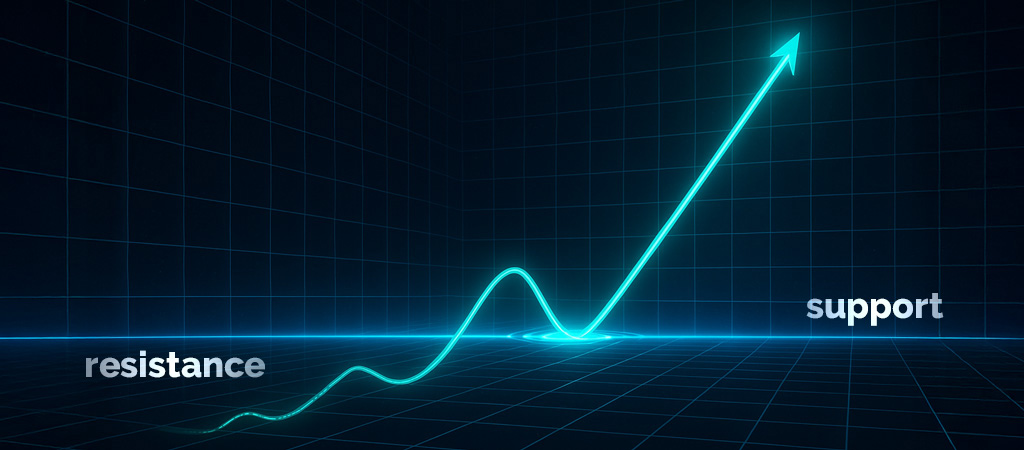
- Understanding support and resistance using horizontal levels and similar tools
By combining these analysis methods and trading only where you have an edge, you’ll cut down on unnecessary trades and improve your win rate.
Please also check out the following articles.
Improving Your Risk-Reward Ratio
Beyond win rate, it’s also important how much a single winning trade can recover relative to a single losing trade.
- Aim for a risk-reward ratio of at least 1:1.5
- Have a strategy for letting profits run when you catch a big trend
- Execute stop losses and take profits based on clear rules
This way, you can be profitable overall even if your win rate falls below 50%.
Rigorous Money Management and Mental Management
No matter how good your analytical skills are, you can’t keep winning at trading without solid money management and mental management.
- Don’t risk more than 1-3% of your total capital on a single trade
- Take a break from trading after a losing streak
- Keep a trading journal and do reviews and self-analysis
By strictly following these rules, you won’t get thrown around by short-term losing trades and can aim for long-term success.
Build Statistical Backing Through Practice
Above all, practice a lot. There are plenty of apps and services out there that let you practice trading. Once you’ve learned the basics of trading, try actually practicing with those apps. If you do it for at least a few months, you’ll start to see whether your method can win. It’s important to start live trading only once you’re confident that, even if you lose some trades, you’ll end up positive overall.
Summary: FX Trading Is Not Something You “Can’t Win”
The reasons so many traders lose at FX come from a combination of factors: a probabilistic disadvantage, psychological biases, lack of skill, mental weakness, and more. However, by understanding these problems and taking the right countermeasures, it’s entirely possible to become a winning trader.
What matters is not chasing an overnight “sure-win method” or “holy grail,” but understanding the true nature of the market, steadily building your skills, and practicing proper money management and mental management. Ultimately, by having confidence backed by practice and statistics that “I’ll lose sometimes, but I’ll end up positive,” you’ll be able to keep trading consistently.
Next time, I’ll explain “How to Build the Mindset of a Winning Trader.” Stay tuned!